Jul 14, 2026 · Sourcing · 7 min read
Rice-Straw Firelighters: A Category Primer for Buyers
What the product is, which specification lines to check, and how to test the three adjectives the category leans on.
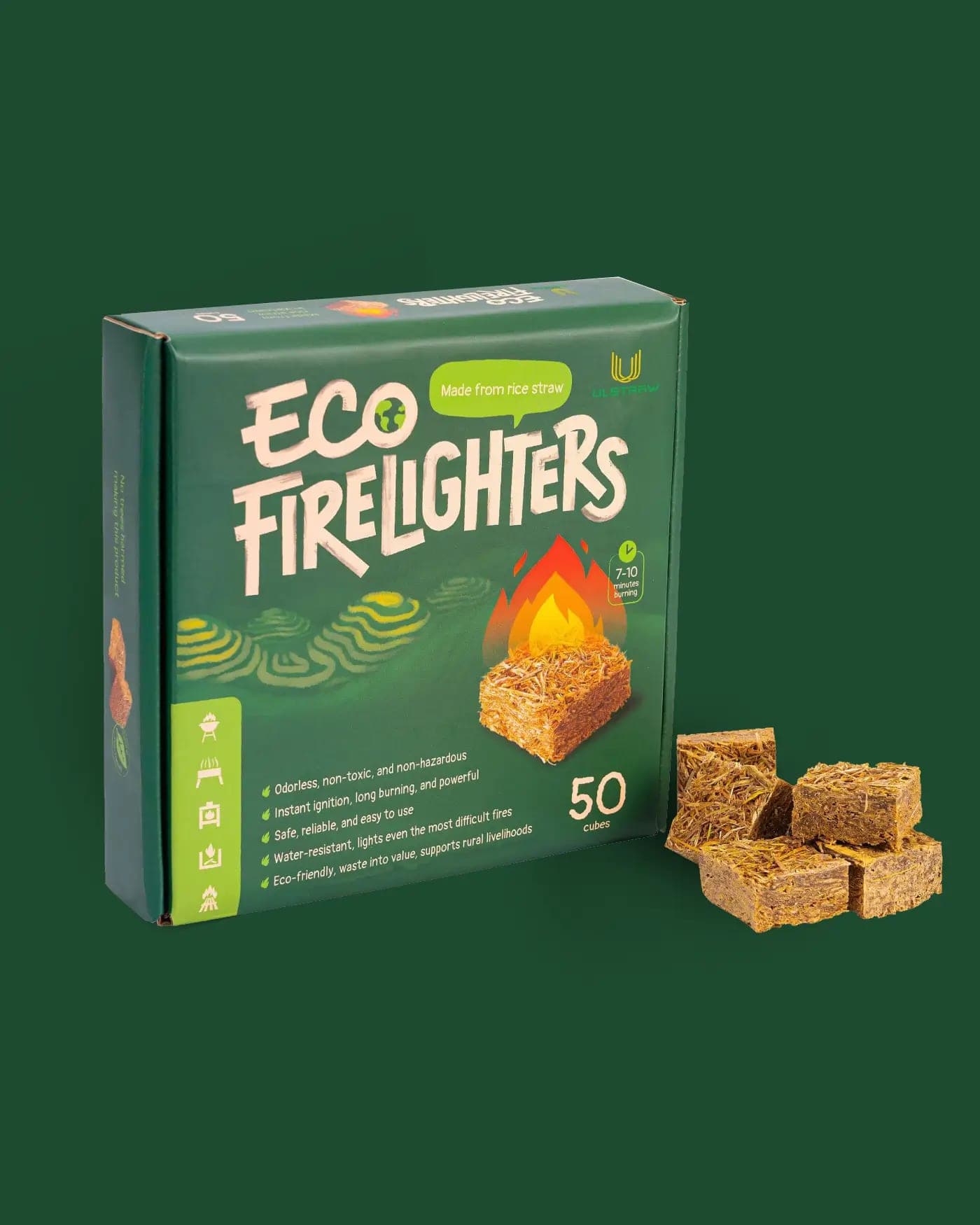
Rice-straw firelighters reach a sourcing shortlist from two directions: a buyer looking for a wood-wool alternative with a different origin story, and a buyer told to take petroleum-based ignition products out of a private-label range. Both arrive at the same first question — what is actually in the block, and which lines of its specification can the supplier evidence?
This primer answers that at category level and then lists the specification lines worth putting in a first enquiry. It is written for sourcing, private-label and distribution buyers, not as a usage guide.
The short answer
A rice-straw firelighter is a block of field-dried rice straw, compressed and sealed with candle wax. It is lit directly and burns with a steady flame long enough for wood, charcoal or pellets to catch. Ulstraw presses it into cubes and bars in Thanh Hoa, Vietnam, for retail and private-label programmes.
What a rice-straw firelighter is
Rice straw is the vegetative residue left in the field once the grain has been taken off at harvest. The International Rice Research Institute treats its handling as a management problem in its own right, separate from the grain, because the volume arrives all at once and has to go somewhere within days.
A rice-straw firelighter takes that residue, dries it, compresses it into a fixed shape and seals it with candle wax. The wax does two jobs: it holds the fibre together so the block survives packing and transport, and it supplies the sustained flame once the block is lit. The Ulstraw catalogue states the composition as rice straw and candle wax for every SKU, cubes and bars alike — it is on the 50 Cubes product page, readable before you speak to anyone.
The specification lines to check first
Everything in the table below is already published, so it can be verified against the listing rather than taken on trust. Figures that belong to a production programme rather than a retail pack — minimum order quantity, lead time, monthly capacity — sit on the ODM page, and are open questions until they are confirmed.
| Specification line | What is published today | Where it is published |
|---|---|---|
| Composition | Rice straw and candle wax | Product pages, per SKU |
| Formats | Pressed cubes and pressed bars | ODM programme page |
| Retail pack counts | 50 and 100 cubes; 30 and 50 bars | Product pages |
| Pack weight | 600 g (50 cubes) up to 1,200 g (100 cubes and 50 bars) | Product pages |
| Pack dimensions | 21 × 20 × 4.5 cm (50 cubes) up to 21 × 20 × 8 cm (100 cubes) | Product pages |
| Burn window | 7–10 minutes, stated by the manufacturer | Product pages |
| Shelf life | 2 years | Product pages |
| Storage | Cool, dry place, kept away from fire | Product pages |
| Origin | Vietnam — pressed in Thanh Hoa | About and ODM pages |
| Minimum order quantity | On request — ask in your brief | ODM programme page |
| Lead time | On request — ask in your brief | ODM programme page |
| Monthly capacity | On request — ask in your brief | ODM programme page |
Read the burn window carefully, because this is where category comparisons usually go wrong. Seven to ten minutes is the manufacturer’s statement, published on the product pages. It is not a third-party test result: the burn-time and moisture test protocol is not fixed yet, so no test report is published here and none is claimed. Ask every supplier on your shortlist which of those two kinds of number they have just quoted you, and the shortlist gets shorter quickly.
Three words to pin down before you buy
Three adjectives do most of the selling in this category, and few of them survive due diligence unchanged. Define them in the specification rather than in the marketing, and attach the evidence to each one.
- Natural — taken here to mean that the body of the block is an agricultural residue rather than a synthesised fuel. The evidence is the composition line published per SKU: rice straw and candle wax. It carries no emissions claim and no health claim, and should not be asked to carry one.
- Odourless — taken here to mean no added fragrance and no petroleum-distillate smell in handling. The evidence today is the published composition and product description. There is no odour test protocol yet, so treat it as a description of the formulation rather than a measured result.
- Eco-friendly — taken here in the narrow sense that the fibre is a harvest residue that had to be dealt with anyway, which is the problem the IRRI material below describes. Ulstraw publishes impact figures elsewhere on this site, but the method behind them is not published, so this article states no quantity. If a number is going into an ESG file, ask for the methodology first and the figure second.
The five lines that save a month of email
A first enquiry carrying these five lines usually comes back with a usable answer instead of a brochure.
- The format and pack count you intend to retail, plus the pack weight your logistics team can accept.
- Which documents you want alongside the first sample: specification sheet, safety data sheet, certificate of origin.
- Whether any burn, moisture or odour figure you are quoted is a manufacturer statement or a test result, and who ran the test.
- The label languages, and the market each pack will be sold into.
- Volume for the first twelve months, and the date goods have to be on the water.
Once the category is clear, the next decision is commercial rather than technical: whether you are buying OEM, ODM or private label. That choice decides who owns the artwork, the tooling and the specification, and it is covered in the buying guide to OEM, ODM and private label.
Sources
- International Rice Research Institute, Rice Straw Management — rice straw as the residue left at harvest, and the management options open to a grower.
- Ulstraw product catalogue — composition, pack counts, pack weights, pack dimensions, shelf life and the stated burn window, published per SKU at /products.
- Ulstraw ODM and private-label programme — formats offered, pack configurations, markets served, the four-step sampling process and the documentation list, published at /odm-private-label.
About the author
Written by Nguyễn Xuân Tài, founder and chief executive of ULSTRAW joint stock company (tax code 2803119239), the Thanh Hoa manufacturer that presses rice straw into firelighters. He presented the project when it won the Start-up category of the Social Business Creation competition in October 2023, and he answers ODM and private-label briefs himself. More on the company and how it is structured is on the about page.
Revision history
Published in this revision. Figures shown as “on request” are open questions logged in the repository, not omissions; this article is updated in place on the day each one is confirmed, and the change is noted here.
Next step
If you are evaluating Ulstraw as a supplier, start with the ODM and private-label programme page: it carries the current specification table, the four-step sampling process and the documentation list. To request a sample or a quotation, use the contact form and state your market, the volume you expect in the first twelve months, and the date you need goods on the water.
Ready for a cleaner way to light your fire?
Explore Ulstraw fire starters