Aug 18, 2026 · Packaging · 7 min read
Packaging Options for Retail Firelighter Programmes
Pack count, barcode, carton and label language decide the listing before the product does. What to specify, and who owns each decision.
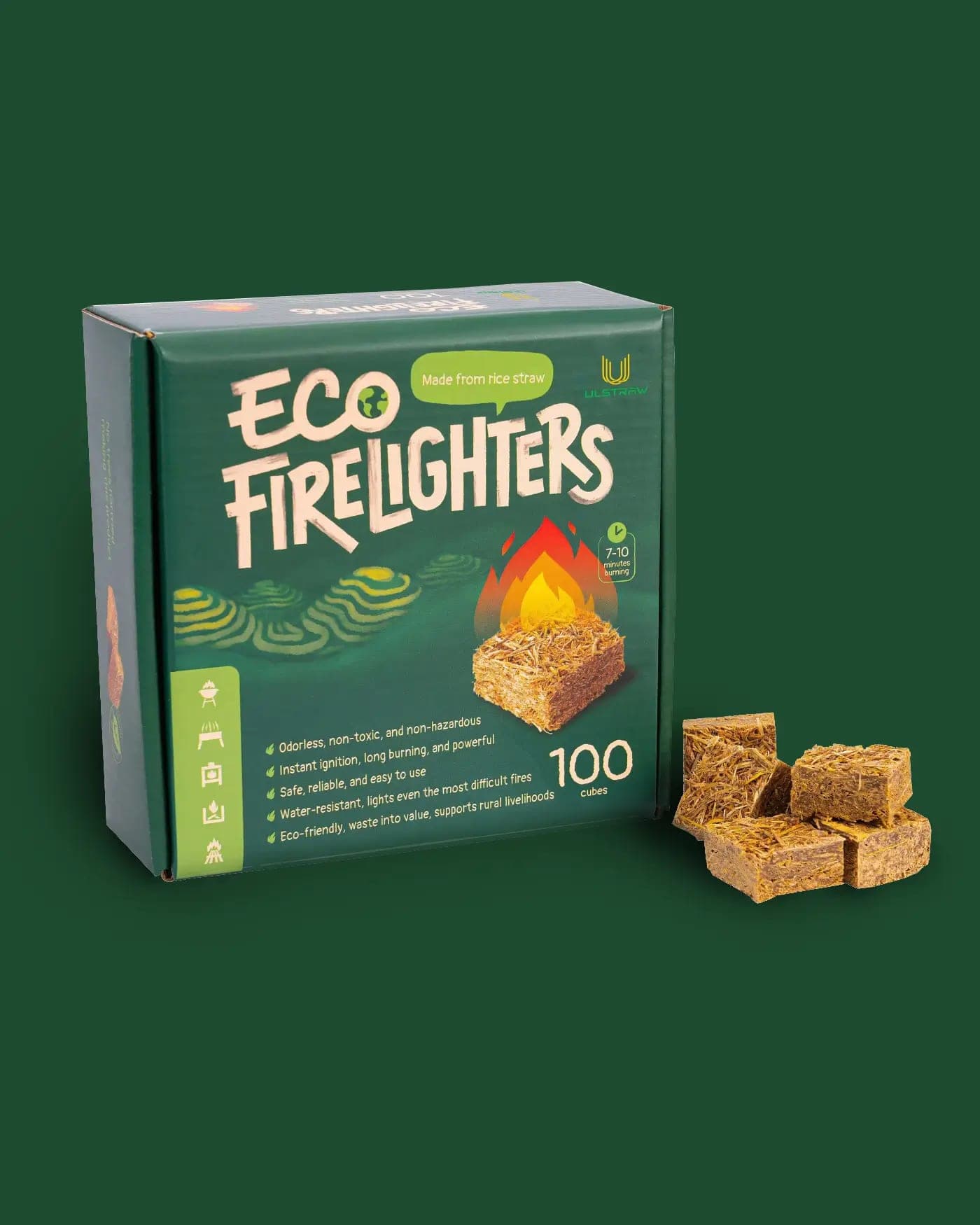
In a firelighter programme the packaging decisions are made first and changed last. Pack count sets the shelf price, the barcode decides who owns the listing, the carton decides the freight cost, and the label language decides which markets the same production run can serve. None of them is a design question.
This article sets out the four decisions, who owns each one, and what a manufacturer needs from you before artwork can go to print.
The short answer
A retail firelighter programme needs four decisions settled before artwork: how many pieces are in a pack, which barcode identifies it, how packs are cased into a carton, and which languages appear on the label. The brand owner decides all four; the manufacturer prices and produces against them.
The four decisions in one table
| Decision | Who owns it | What the manufacturer needs from you |
|---|---|---|
| Pack count | You. It sets shelf price and units per carton. | The count, and whether it must match an existing tooled configuration. |
| Primary pack | You, within the formats the line runs. | Material, finish and closure, plus a reference pack if one exists. |
| Barcode | You, as brand owner. | The GTIN itself, in the symbology and print quality your retailer demands. |
| Carton configuration | Shared — your retailer’s rules, the manufacturer’s packing reality. | Units per carton, and any pallet or case-marking rule your buyer imposes. |
| Label languages | You, per destination market. | The list of languages, and the exact wording you are obliged to carry. |
| Artwork | You. | Print-ready files with bleed, plus the dieline for the chosen pack. |
| Pallet and export marks | Shared. | On request — ask in your brief |
Pack count is a freight decision wearing a merchandising costume
The counts already running on this line are 50 and 100 cubes, and 30 and 50 bars, at 600 g to 1,200 g per pack. Those are the cheapest place for a programme to start, because they are already packed and their pack dimensions are published: 21 × 20 × 4.5 cm for the 50-cube pack up to 21 × 20 × 8 cm for the 100-cube pack.
A new count is possible, and it changes three things at once: the shelf price, the number of packs that fit a carton, and the cube of the pallet. Decide it against the carton, not against the shelf alone, or you will re-tool a pack that ships badly.
The barcode belongs to you
A retail barcode encodes a Global Trade Item Number, the identification key GS1 defines for trade items that are priced, ordered or invoiced. The GTIN is allocated by the company whose brand is on the pack, which in a private-label programme is you, not the factory. Get it issued in your own name before artwork, and keep it there: a barcode issued under a manufacturer’s prefix ties your listing to that manufacturer even after you leave.
Ask your retailer which symbology and print-quality grade they require, and put it in the artwork brief. It is cheaper than a reprint.
Label languages and the line this article will not cross
Language choice is partly commercial — one multilingual pack that serves several markets versus separate runs per market — and partly obligatory. The obligatory half is a compliance question, and this site does not publish a standard number or a labelling requirement until it has been verified for the destination market in question. Market compliance and labelling confirmation is issued per market and on request, and that is deliberately where it stays until the verification exists.
What that means in practice: bring the labelling requirements you are already obliged to meet into the brief at step one, rather than discovering them at artwork approval. Every step of that route is described in the OEM, ODM and private-label buying guide, and the formats and pack configurations available today are on the ODM programme page.
What to send with the artwork
- Print-ready artwork with bleed, against the dieline for the chosen pack.
- Your GTIN, plus the symbology and print-quality grade your retailer requires.
- The language list, and any wording you are obliged to carry verbatim.
- Units per carton, and any case-marking or pallet rule your buyer imposes.
- The market each variant is destined for, so that packs are not mixed on the run.
Sources
- GS1, Global Trade Item Number (GTIN) — the identification key that sits behind a retail barcode.
- Ulstraw product catalogue — composition, pack counts, pack weights, pack dimensions, shelf life and the stated burn window, published per SKU at /products.
- Ulstraw ODM and private-label programme — formats offered, pack configurations, markets served, the four-step sampling process and the documentation list, published at /odm-private-label.
About the author
Written by Nguyễn Xuân Tài, founder and chief executive of ULSTRAW joint stock company (tax code 2803119239), the Thanh Hoa manufacturer that presses rice straw into firelighters. He presented the project when it won the Start-up category of the Social Business Creation competition in October 2023, and he answers ODM and private-label briefs himself. More on the company and how it is structured is on the about page.
Revision history
Published in this revision. Figures shown as “on request” are open questions logged in the repository, not omissions; this article is updated in place on the day each one is confirmed, and the change is noted here.
Next step
If you are evaluating Ulstraw as a supplier, start with the ODM and private-label programme page: it carries the current specification table, the four-step sampling process and the documentation list. To request a sample or a quotation, use the contact form and state your market, the volume you expect in the first twelve months, and the date you need goods on the water.
Ready for a cleaner way to light your fire?
Explore Ulstraw fire starters